
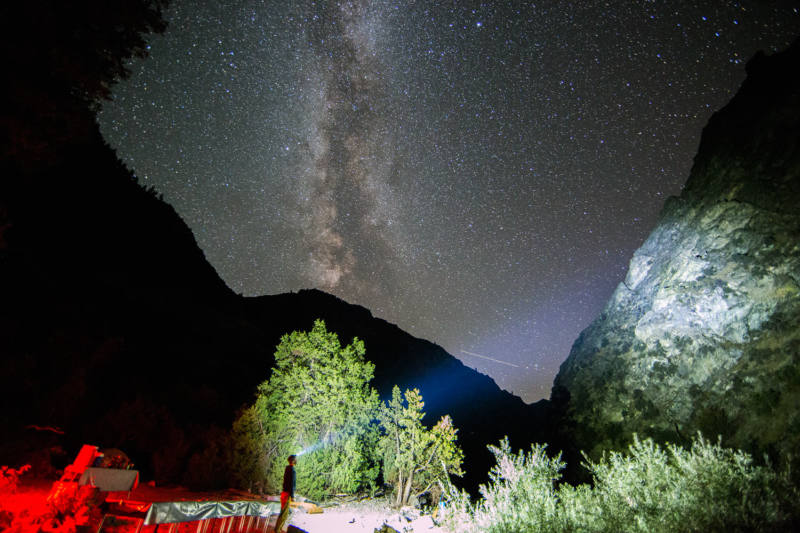
Idaho’s dark skies offer ideal conditions for observing the night sky. From meteor showers and eclipses to planetary events, here’s what to watch for in 2026.
Moon Cycles
- January 3: Full Moon, Supermoon.
- January 18: New Moon
- February 1: Full Moon
- February 17: New Moon
- March 3: Full Moon (see Eclipse section)
- March 19: New Moon
- April 2: Full Moon
- April 17: New Moon
- May 1: Full Moon
- May 16: New Moon
- May 31: Full Moon
- June 15: New Moon
- June 29: Full Moon
- July 14: New Moon
- July 29: Full Moon
- August 12: New Moon. Best viewing night for the Perseid meteor showers.
- August 28: Full Moon
- September 11: New Moon
- September 26: Full Moon
- October 10: New Moon
- October 26: Full Moon
- November 9: New Moon
- November 24: Full Moon, Supermoon
- December 8: New Moon
- December 23: Full Moon, Supermoon.
“Supermoons” occur when the full Moon is near perigee, its closest orbital point to Earth. For 2026, these include: January 3, the first supermoon of 2026. November 24, second supermoon. December 23, third supermoon
Eclipse Seen From Idaho
March 3, 2026 – Total Lunar Eclipse: On March 3, a total lunar eclipse will be visible across Idaho. The eclipse will begin in the early hours of the morning, with totality starting at 1:44 AM MST, peaking at 4:33 AM, and ending at 7:23 AM. Weather permitting, this will be a fantastic opportunity to witness the moon take on a deep red hue as it passes through Earth’s shadow.
August 27–28, 2026 – Partial Lunar Eclipse: On the evening of August 27, a partial lunar eclipse will be visible across Idaho. The eclipse will begin at 7:23 PM MDT, reach its maximum at 10:12 PM, and end at 1:01 AM on August 28. During this time, part of the moon will pass through Earth’s umbra, creating a noticeable dark shadow on the lunar surface — a subtle but beautiful celestial event.
Milky Way Viewing Season — Idaho, 2026
In 2026, the best time to view the core of the Milky Way in Idaho is from late March through early October. However, the peak season, when the galactic center is above the horizon during true nighttime darkness, is from May to August. The Milky Way is visible earlier in the morning in spring and gradually becomes an evening object as summer progresses.
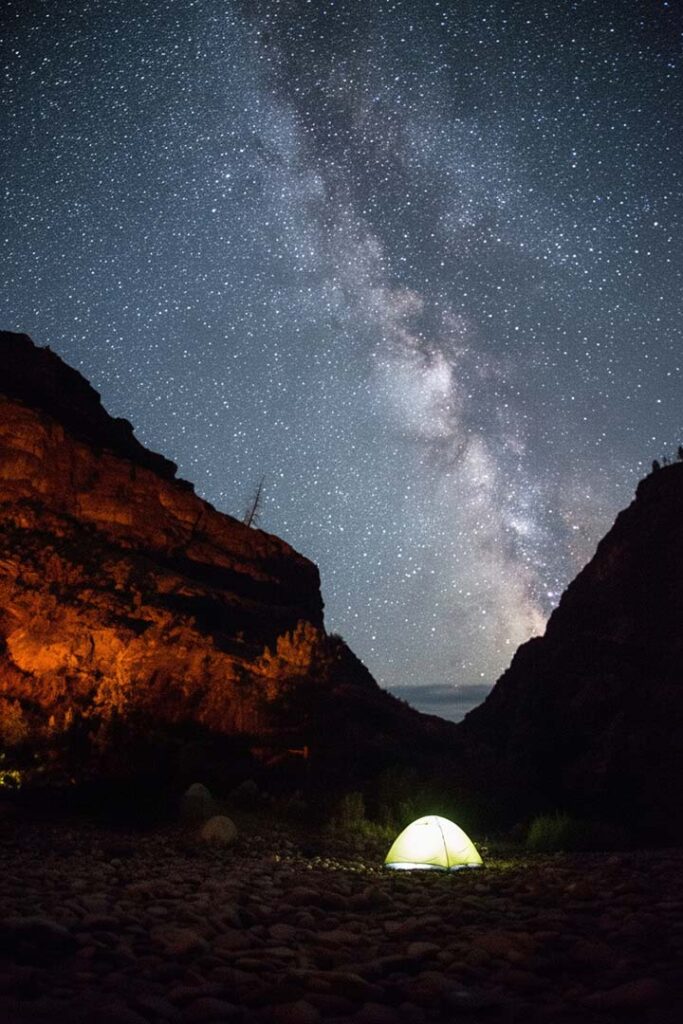
Photo from Cradle Campsite on the Middle Fork Salmon River.
Best Nights for Milky Way Viewing in 2026
To see the Milky Way clearly, aim for moonless nights or those near the new moon. Here are the best new moon nights during peak Milky Way season:
- April 17 – Excellent early-morning core viewing
- May 16 – Milky Way visible in early hours
- June 15 – Ideal for midnight-to-pre-dawn photography
- July 14 – Prime summer viewing with warm weather
- August 12 – Perfect pairing with the Perseid meteor shower
- September 11 – Evening views before the core sets
Meteor Showers
There are a number of meteor showers throughout the year, but here are two of the best ones to mark on your calendar for 2026:
August 12–13 – Perseid Meteor Shower
The Perseids are one of the most popular meteor showers, known for their bright, fast streaks. In 2026, they align perfectly with the new moon, offering ideal dark-sky viewing.
December 13–14 – Geminid Meteor Shower
Often considered the best meteor shower of the year, the Geminids will shine brightly in 2026. While a waxing crescent moon sets early, skies will be dark during peak hours, making for excellent viewing conditions.
Rare Planetary Alignments and Conjunctions
January 10, 2026 – Jupiter at Opposition
Jupiter reaches opposition on January 10, meaning Earth passes between Jupiter and the Sun. This makes Jupiter the brightest it will be all year and visible all night long. It’s a great time to spot the giant planet with the naked eye, binoculars, or a small telescope. Star Walk
February 28, 2026 – Planetary Alignment
On February 28, several planets — including Mercury, Venus, Neptune, Saturn, Uranus, and Jupiter — form a wide alignment in the evening sky. While not all planets will be easy to see without binoculars or a telescope, this grouping creates an unusual and rewarding sight for skywatchers. Star Walk
June 8–9, 2026 – Venus–Jupiter Conjunction
On the evenings of June 8 and 9, Venus and Jupiter will appear close together in the western sky just after sunset. This pairing of the solar system’s two brightest planets will be easy to spot with the naked eye and makes for a beautiful planetary duet over Idaho’s twilight. National Geographic
August 12, 2026 – Large Morning Planetary Alignment
On August 12, multiple planets — including Jupiter, Mercury, Mars, Uranus, Saturn, and Neptune — line up in the morning sky. While some will require binoculars or a telescope, this alignment accompanies the peak of the Perseid meteor shower, making it a special triple treat of planets, meteors, and dark skies. Star Walk
October 4, 2026 – Saturn at Opposition
Saturn reaches opposition on October 4, rising at sunset and visible throughout the night. Its rings will be well‑placed for observation with binoculars or a small telescope, and it stands out as a distinct point of light in the autumn sky. February 28, Planetary Alignment: For the first time in years, all seven of the solar system’s other planets will appear together in Earth’s skies. This rare alignment is a must-see event. Find a dark-sky location and bring binoculars or a telescope for the best views.
